
Look at the air near a busy road on a dry day. You can often see dust rising behind each truck. Near a port, a factory or a construction site, the same thing happens all day long. Fine dust and smoke from engines hang in the air, and people nearby breathe them in.
Planting trees is not the only answer, and it does not replace cleaner fuel or better controls. But a dense forest is one of the most useful tools we have to reduce the problem, and it brings other benefits at the same time.
Where the dust and fumes come from
- Trucks and heavy vehicles lift dust from roads and open ground, and add exhaust.
- Ships and machines burn fuel and release smoke and fumes.
- Bare, cleared land has loose soil that the wind and traffic blow around.
- Construction and industry add more dust and particles.
How a forest helps
Leaves are surprisingly good at catching dust. Their surfaces, and the tiny hairs and ridges on them, hold particles that would otherwise stay in the air. When rain falls, much of it washes down to the soil.
A forest also helps by:
- Holding the soil in place. Roots and ground cover stop the ground from turning into dust.
- Cooling the ground. Shade and mulch keep soil damp so it does not blow away.
- Slowing the wind. A thick belt of trees breaks the wind and lets heavy dust settle.
- Taking in gases. Trees take in carbon dioxide as they grow.
The thicker and more layered the forest, the more leaf surface it has to work with. That is why dense planting suits dusty places.
The JNPT example
The Jawaharlal Nehru Port (JNPT) at Nhava Sheva is India's largest container port. Large ships and a constant stream of trucks keep it running, and that activity brings emissions, dust and land degradation. The port authority, JNPA, chose to give back to the ecosystem it works in.
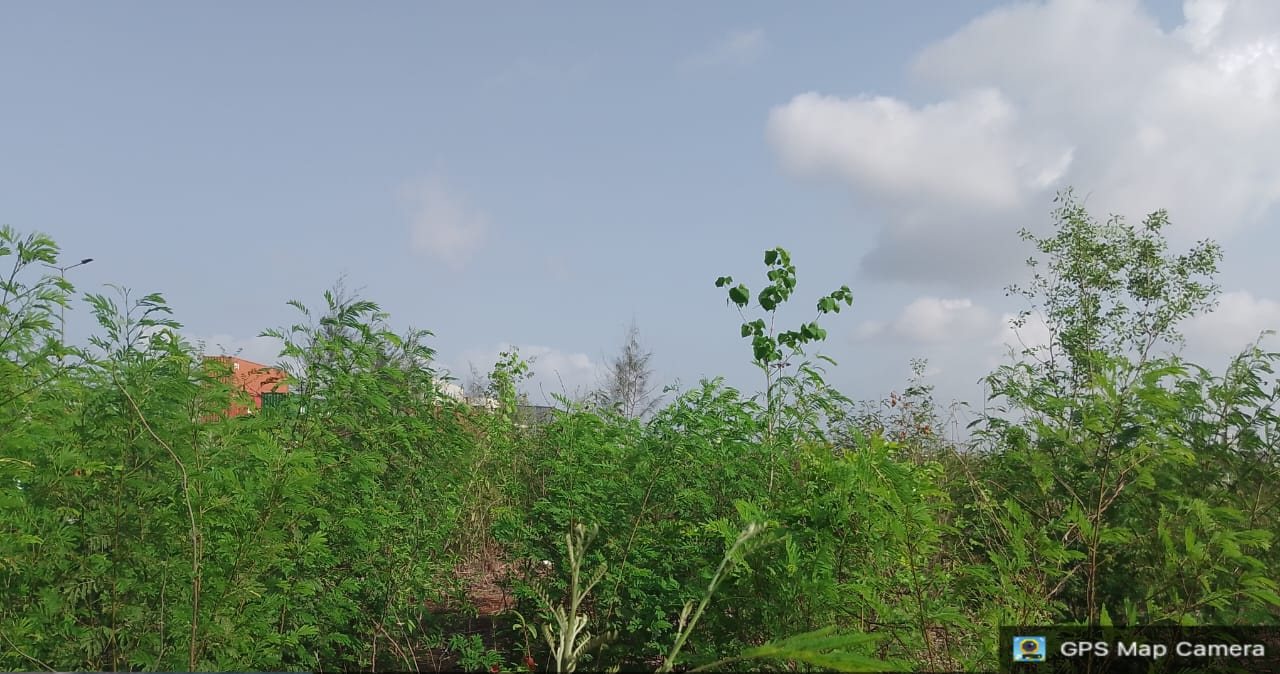
With support from SBI Foundation, Forest Creators turned seven acres of barren, salty land at the JNPT SEZ into a dense native forest. The signboard on site records 1,09,627 trees of 79 varieties. Photographs taken over time show bare ground becoming a thick green belt beside the port road.
Why native trees for this job
On harsh sites, native and salt-tolerant species do best. At JNPT we planted only trees that could handle the salt and the wind, and used rows of natural windbreak trees to protect the young ones. A forest that survives for decades will keep catching dust for decades.
What a forest cannot do alone
A forest is not a substitute for cleaner engines, covered loads, wet roads and good site practices. It works best as part of a wider plan. What it does well is give a lasting, living layer of protection, and also a home for wildlife.
A good use of green budgets
For ports, factories and industrial estates, a dense forest on the edge of the property is useful in many ways. It reduces dust on its borders, improves the look of the area, supports a green image and helps meet environmental goals. It can also form part of CSR and sustainability reporting.
Frequently asked questions
Do trees really reduce dust?
Yes. Leaves catch dust particles and roots hold the soil in place. Dense, layered forests do this better than a few scattered trees.
Can trees fix port pollution on their own?
No. Trees help, but they work best together with cleaner technology and good site management.
What kind of land can be planted?
Even harsh land, such as salty or compacted ground, can often be planted with the right preparation and the right native species.
Running a port, factory or industrial estate? Talk to Forest Creators about a green belt that lasts.
Talk to Forest Creators