
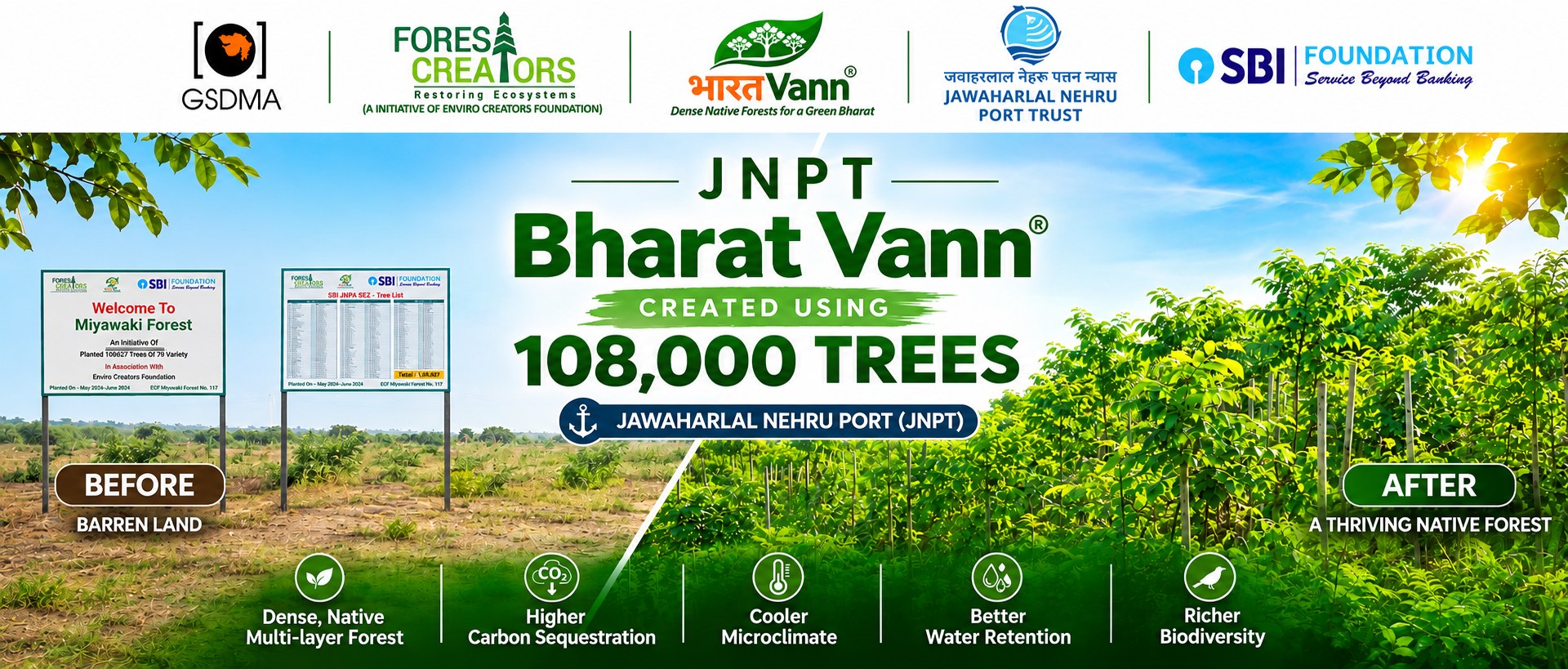
Some stories are best told in two photographs. The first shows flat, orange, bulldozed ground beside a high wall, with a few lonely shrubs. The second shows a thick, green forest with young trees standing tall on bamboo stakes. Between those photographs lies the story of the JNPT forest.
The place: India's largest container port
The Jawaharlal Nehru Port (JNPT) at Nhava Sheva is India's largest container port. Large ships come and go, and trucks carry containers in and out day after day. That keeps the country's trade moving, but it also brings emissions, dust and degraded land.
The port authority, JNPA, wanted to give back to the ecosystem it works in, as part of its vision of becoming a Green Port.
The partner: SBI Foundation
SBI Foundation, the CSR arm of State Bank of India, gave a grant to plant 1,08,000 trees at the JNPT SEZ. The project, SBIF CONSERW: ARANYA, was carried out with JNPA, and Forest Creators planned, planted and now cares for the forest.
The challenge
This was a hard site. Four problems stood out:
- Poor, compacted soil with few nutrients and little life
- Salt and harsh weather from the nearby sea and strong winds
- Scale and logistics, with over a lakh saplings to plant on seven acres inside an active Special Economic Zone
- Doubts about the method, because the Miyawaki method is usually used on much smaller plots
The solution
- The soil was brought back to life with organic compost, biochar, cocopeat and beneficial microbes, recreating a forest floor.
- Salt-tolerant native species were chosen, and rows of natural windbreak trees protected young saplings from coastal wind. Mulch kept moisture in.
- Planting was done in phases, with the land divided into small zones and quality-control teams checking spacing, variety and care.
- Partners were shown the results through visits, workshops and growth data, until doubt turned into support.
The result
The signboard on site reads: "Welcome to Miyawaki Forest. An initiative of SBI Foundation. Planted 1,09,627 trees of 79 varieties, in association with Enviro Creators Foundation. Planted May to June 2024. ECF Miyawaki Forest No. 117."
Photographs over time show the change. Bare, bulldozed ground. Planting day with workers and mulch. Young saplings supported by bamboo stakes. Then a thick green forest, where flowers like hibiscus, oleander and frangipani now bloom. The site has become a living laboratory for students, researchers and climate advocates.
What this shows
- A hard, industrial, coastal site can become a forest.
- CSR funding can become something that keeps growing for decades.
- A dense native forest can sit right next to a port.
- Local people can do much of the work.
Frequently asked questions
Who funded the JNPT forest?
SBI Foundation, the CSR arm of State Bank of India, supported the project with a grant for 1,08,000 trees.
How many trees are there?
The project signboard records 1,09,627 trees of 79 varieties, planted in May to June 2024.
Can other ports or industrial areas do the same?
Yes. With the right soil work and species choice, even harsh coastal sites can become forests.
Want a forest like the one at JNPT? Talk to Forest Creators about your site or your CSR plans.
Talk to Forest Creators